2nd Ziess Dental Symposium London

Carl Zeiss bietet Fortbildungsprogramm für Zahnärzte und Dental-Spezialisten an Carl Zeiss Offers Advanced Training Program for Dentists and Dental Specialists

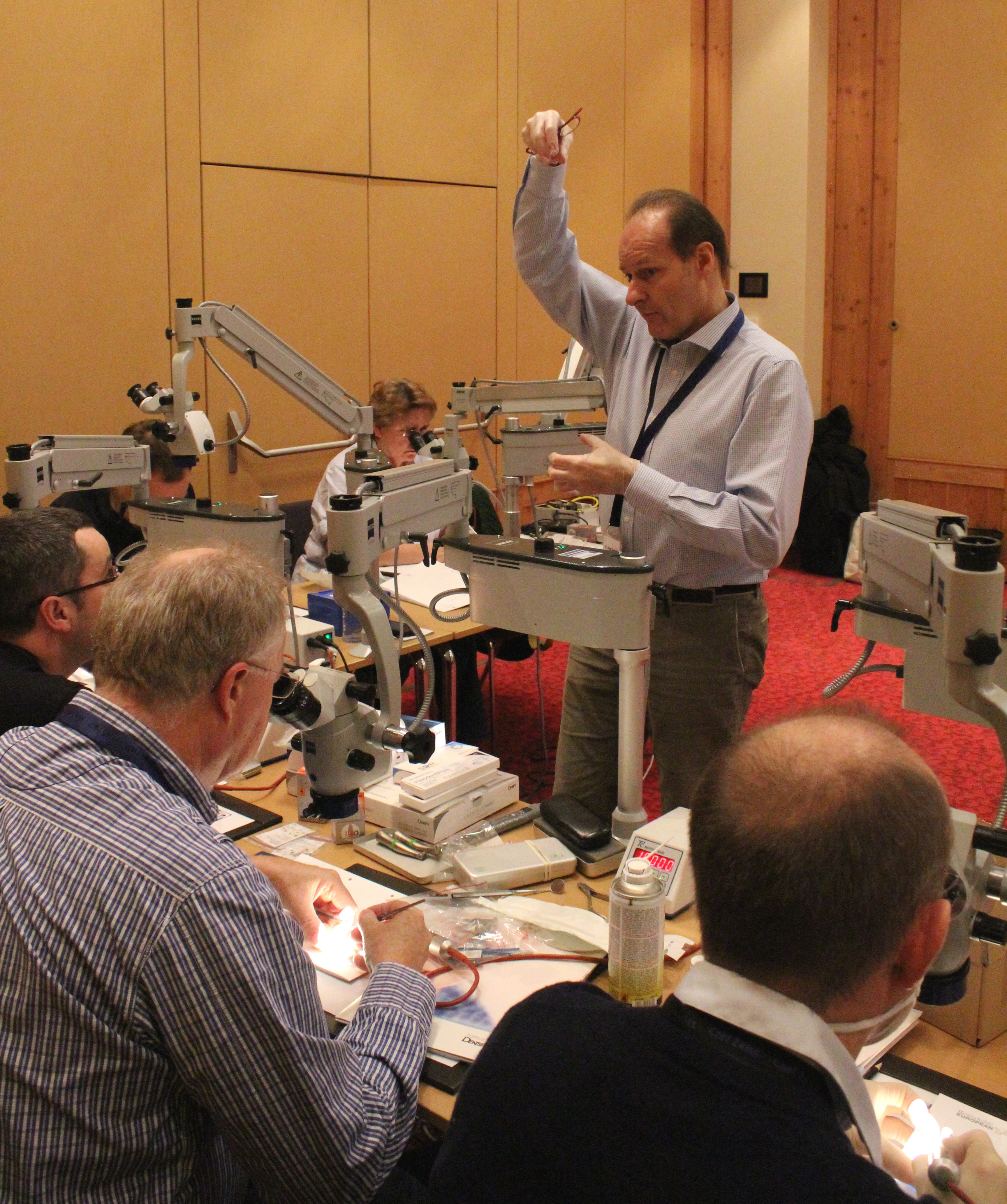
Yesterday I attended the second dental symposium on surgical microscopy hosted by Zeiss. I think these symposia are great as they bring together some of the most skilled dental surgeons in the world to talk on the advances in micro-surgery. Its quite simple, the better you can see what you are doing the better you can do the surgery.

The first speaker was Prof. Krejci on the ‘Geneva Concept’. In summary decay and gum disease is a highly infectious incurable chronic disease and we acquire the bacteria responsible for it at birth. Therefore since we can’t cure it we need to focus on prevention and conservation of damaged tissues. To quote “There is no such thing as a permanent restoration, they are all temporary until the last one”. The easiest and most cost-effective treatment is early intervention and the use of adhesive materials such as resins and composites. With the use of microscopy we can preserve tooth tissue because it’s so much easier to see small defects and cavities in the teeth and precisely repair them.

Dr Rino Burkhardt’s subject was ‘Minimally invasive periodontal surgery and its effects on wound healing’. In essence success depends on maintaining the microscopic blood supply to promote rapid healing and was best achieved by adopting the skills from the other surgical disciplines such as eye and microvascular surgery.

Dr Domenico Massironi (one of my personal heroes) gave a beautiful presentation on the use of surgical microscopes in aesthetic dentistry. Only with improved vision can we truly assess the quality of our work and achieve the precision that our patients deserve. Check out his video (its only in Italian but that does not matter watch it anyway)

http://www.youtube.com/watch?feature=player_embedded&v=vFiCb9CPnZg

In the afternoon followed three excellent lectures by Prof. Gilberto Debelian, Dr Tony Struttman and Dr Tomas Lang on root fillings, retreating failed root fillings and micro-invasive dentistry. If a tooth can be reasonably saved there are huge advantages to the patient than losing it and hoping that an implant will perform any where as well.This may not have been so 15 years ago but microscopy now allows us to literally look down the root of a tooth which was impossible before then. It’s hard to out engineer nature.

The final presentation was from Oscar von Stetten on using the microscope to document our treatment and communicate what we see down the microscope to colleagues and patients. If our patients truly understand what we as clinicians are trying to achieve the better the treatment outcomes. Below is a picture of a cracked back tooth which helped the patient understand why it hurt every time they bit on it.

DSC_0010

Dentistry and the Classic Car

DSCF1468

I am going to quote here from a book by Matthew Crawford called ‘The Case for Working with Your Hands’.

“Some arts reliably attain their object – for example the art of building. If the building falls down , one can expect to say in retrospect that the builder didn’t know what he was doing. But there is another class of arts that Aristotle called ‘stochastic’. An example would be medicine (or in our case dentistry). Mastery of a stochastic art is compatible with failure to achieve its ends (health). As Aristotle writes, “It does not belong to medicine to produce health, but only to promote it as much as possible…”
Fixing things , whether cars or human bodies, is very different from building things from scratch. The mechanic and the doctor deal with failure every day, whereas the builder does not. this is because the things they fix are not of their own making,and are therefore never known in a comprehensive or absolute way.

The vast majority of us are born with a perfect set of teeth  crafted by mother nature to last a lifetime. Unfortunatly in many cases the use and abuse of modern life takes its tole on these marvels leading to decay, gum disease, extractions and fillings. What I am trying to get at is that the dentist did not make your teeth for you but has the challenging job of trying to fix the wear and tear they are exposed to. Fixing broken and worn out things can therefore be unpredictable, expensive and time consuming.

So like classic cars its easier to buy and maintain a good example than a rusted barn-find unless you are prepared to spend a lot of time and effort in its restoration, and sometimes its just impossible even when both cars were designed by a Porsche to turn one into the other.

Porsche-LMP1-2_2588603b

Better Choices

image

Compared to twenty years ago one of the major changes in healthcare in the dramatic increase in choice. Choice can be good and it can also be bad so how do we both as dentists and patients choose the best treatments.Here is a short list that may help.
There is no perfect treatment,all have various pros and cons that need to be carefully considered. A treatment that most suits a person in their twenties may be totally unsuitable for a person in their eighties.
The only way to know if a treatment is reliable or not is to see how it stands the test of time. Most anything can be deemed successful over 18 months but what is the success rates at 5 and 10 years later. We therefore need to be a little wary of ‘the newest or latest’ therapies if there is no medium to long term reliable research backing up the claims.
When making a choice it is always best initially to look at all your options impartially as though time and money do not exist and then carefully strike out the unsuitable choices. You may be surprised once you know all your practical choices and how successful each of them is over time that selecting the right treatment becomes very simple.
Our practice philosophy is to try and tailor the best treatment to each patients personal needs both in the short, medium, long term and budget.
Using special equipment and techniques like digital imaging and surgical microscopy we have been able to dramatically improve long term success when it comes to saving teeth. The ability to prolong the health of your own teeth has many advantages over implants for example, both in terms of aesthetics, function and reducing the need for surgery. That is not to say that in some cases implants are not the best treatment but I think all other practical solutions need to be carefully considered before making that choice.