What Is Evidence-Based Dentistry?

MS_Howe_cropped

I would like to declare an interest here. I am about to start a Masters in Evidence-Based Healthcare at Oxford Universities Centre for Evidence-Based Medicine(EBM).

Having read a recent philosophical take on evidence-based dentistry(EBD) I thought it might be a good idea to review my belief on what EBD is. For arguments sake the principles and ethics of EBM are the same as EBD

To start with let us look at the literature and the place to start is with an editorial paper written by the father of EBM Professor D Sackett et al in 1996 called “Evidence-Based Medicine: what it is and what it isn’t.” The paper is open access in the BMJ. http://www.ncbi.nlm.nih.gov/pmc/articles/PMC2349778/pdf/bmj00524-0009.pdf

For those who don’t want to read the editorial here are couple of paragraphs:

“Evidence based medicine is not “cookbook” medicine. Because it requires a bottom up approach that integrates the best external evidence with individual clinical expertise and patients’ choice, it cannot result in slavish, cookbook approaches to individual patient care. External clinical evidence can inform, but can never replace, individual clinical expertise, and it is this expertise that decides whether the external evidence applies to the individual patient at all and, if so, how it should be integrated into a clinical decision.”

“Evidence based medicine is not restricted to randomised trials and meta-analyses. It involves tracking down the best external evidence with which to answer our clinical questions. To find out about the accuracy of a diagnostic test, we need to find proper cross sectional studies of patients clinically suspected of harbouring the relevant disorder, not a randomised trial.”

EBD should be a process. The first part of this process would be of asking oneself a clinical question such as, “What is the best technique for repairing a porcelain fracture in a crown or bridge?” and then search the databases to see what has been published and critically appraise it. In the most recent clinical trials it turns out that tribochemical silica coating produces a stronger repair than hydrofluoric acid. The second and third components are to incorporate that information into your previous clinical experience and the patient’s wishes and agree on the best course of action.

The problem at the moment is that the philosophy behind EBD/EBM has been to a certain degree kidnapped by the establishment and twisted into GUIDELINES with hard edges of what is right and what is wrong. Yes, there a caveats in the NICE guidelines stating that they are ‘only guidelines’ but woe betide anyone stepping outside of them. As professionals we have a duty to interrogate those guidelines if they conflict with our clinical experience since we are dealing with an individual not a population.

A case in point has been the NICE guidelines of antibiotic prophylaxis. These guidelines currently state there is no evidence that antibiotic prophylaxis for high risk patients having high risk dental treatments in necessary. You can follow the discussion in the BDJ. It is true there are no RCT’s and probably never will be to answer this question, but if you can access the current published data and apply a little bit of statistical rigour the answer is there. NICE is wrong! We should be giving antibiotic prophylaxis, but only to those who are at high risk of endocarditis having treatment that puts them at a high risk of bacteraemia. The risk to the individual far outweighs the benefit to the population.

Another paper recently published on ‘Dental Implants in the Elderly’ shows a 10 year survival rate at 91.2%. This is fantastic, until you pull the paper apart and find that this result is only based on three papers which all have substantial weaknesses, such as 50% missing data etc. The reality from my observations in practice over 18 years would be closer to 70% survival at ten years in this age group with a much higher complication rate. The real headache is that the majority of patients believe that implant treatment will last forever!!!!

A MANIFESTO

It is the duty primary care clinician to use the EBD process to question DoH/NICE/the Industry. The key problem for most clinicians is getting full/free access to the data which is hidden behind various paywalls. Without access to all the available facts it is difficuly to robustly question a lot of the so-called evidence-based guidelines. The FGDP/BDA should promote this free access to its membership.

We need to teach the correct use of EBD and how to search and interpret the data gathered. In theory it has never been easier to find the data

A major problem for dentistry is the length of time it can take for a good or bad technique to reveal itself. What looks like a sound technique after 2 years can become a major maintenance and repair problem after 10 years, especially as the ‘baby-boomers/heavy metal generation’ ages. Correct use of EBD by the primary care technician can fill the gaps were experience is short.

Read Sackett, access the videos from the CEBM on YouTube. EBD is not a journal, it’s the future of quality dentistry.
Auditing the Risk Index


Restorative Dentistry Risk Index Retrospective Test

To test the accuracy of the Restorative Dental Risk Index (RDRX) in predicting the survival of various dental treatments I carried out an audit of my own patients who had been with the practive for 10 years. To add perspective to the results I compared it to the Oral; Health Score (OHS), a modified commercial version of this is known as  Previsor. I have removed the post describing the RDRX to revise it slightly, it will be back by this week-end.

Method

Since we cannot have a 10 year no-treatment control I have used the Oral Health Score (OHS) as described by Burke and Busby as the control. As this is a health score it is by definition the inverse of the risk score so I have modified it by subtracting the OHS from 100 for comparison purposes (100-OHS).

Accessing Software of Excellence Excel I selected all current patients who first attended the practice between January and December 2005. I selected 10 years since the RDRX score was developed on 10 year survival/success meta-analysis data.

The query produced 47 sets of notes. I have assumed the effect size would be large 0.5, p=0.05 and power 0.8 so using G-Power 3.1 software the minimum sample size necessary was 21. I used a computer program to randomly selected 27 records from the 47 for review.

For each set of notes I counted the number of adverse events (failures and complications) and generated a RDRX score and 100-OHS based on the first visit. All major treatment provided in the past 10 years was categorised and recorded with the exception of maintenance and monitoring. (Data available on request)

Results and Analysis

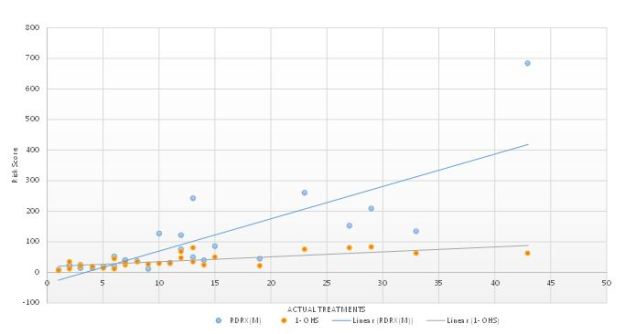
When comparing the risk scores with actual treatment both scoring systems perform well.

100 –OHS has a correlation coefficient 0.72

RDRX has a correlation coefficient 0.80

RDRX10

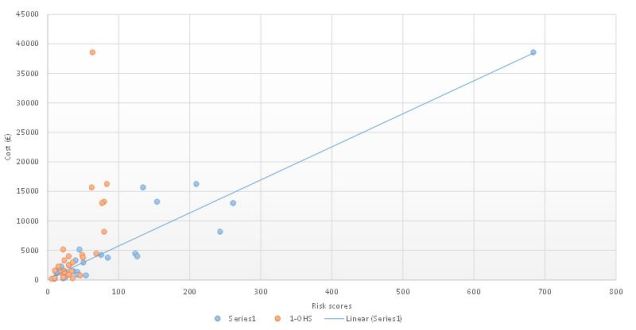
The second important comparison was the correlation between risk and estimated treatment cost

100 –OHS has a correlation coefficient 0.63

RDRX has a correlation coefficient 0.95

RDRX10a

I have also calculated a t-test between the two risk scores /actual treatment (one tailed) data sets. The value of t=2.38. The value of p is 0.013. The result is significant at p<0.05.

Conclusion

We can reject the null hypothesis that there is no difference between the two indices. There is an improvement is resolution when comparing the RDRX with actual treatment as we are not restricted by a maximum value of 100. This is even more obvious when comparing risk score with treatment costs.

Clinical risk is fat tailed where the highest risk patient inhabit the extremes and therefore we need to clearly identify the outliers. On a practical basis the RDRX is more objective by avoiding subjective input from the patient which in the OHS makes up 24% of the score. Additionally it is quicker and easier to directly audit as there is a tooth by tooth assessment rather than by sextant.

The utilisation of independent probabilistic tooth assessment and then the use of risk multipliers produces a clearer model of restorative situation and additionally can easily be converted from a score into a probability that can be verified by Brier Scoring (I will save that for another day).

The RDRX used in conjunction with words of estimative (WEP) probability fulfils the two further requirements of good risk communication which are: numerical magnitude and time frame.

The next stage I hope is to independently verify this data on a wider and more diverse population sample.


Probabilitistic Decision Making

Micro-specialisation and prognosis overestimation

I am a general dental practitioner, a jack-of-all trades in the dental world and possibly becoming an endangered species. To keep updated I travel to a lot of international conferences that cover the dental disciplines such as implants, restorative dentistry, prosthetics, endodontics, and periodontics to name a few. To my mind dentistry is a speciality within general healthcare so the disciplines above should be considered as sub-specialities or micro-specialities of dentistry and over recent years there has been a shift away from the generalist to the specialist (1). What I observed was that each discipline is just a bit better than the other at saving or restoring teeth so at an implant based conference implants outperform root-fillings and vice-versa.  Now if one carefully adds up the success rates across the disciplines of all the treatment options it becomes greater than 100%, which it impossible. What is happening is, due to uncertainty the  clinicians have to use probabilistic data and by restricting the number of treatment options create  overestimates for the relative success or suitability of that treatment. This is a problem of ‘subadditivity’ and the ‘unpacking principle’:

Subadditivity – This is where the sum of two probabilities is greater than 1.0.

Unpacking – As more detail of a hypothesis is provided (unpacked) there is an increase in its estimated probability.

An EBSCO literature search using the search terms “unpacking principle or subaddition” and “medical decision making” produced  three relevant papers with no systematic reviews or meta-analysis(2–4).To summarise the results; in Cahan et al’s paper 65% of the doctors exhibited subadditivity with a mean probability of 137% and Redelmeier et al concluded that clinicians need to unpack a broad category of treatment opptions rather than compare a single treatment against unspecified options.

To help understand these concepts I have worked an example for you below:

“A patient attends a dental surgeon complaining of difficulty chewing due to a loss of lower back teeth. On one side are two premolars and on the other one premolar. Both last standing teeth need new crowns. The upper arch is intact.”

The option are as follows:

  1. No treatment ( I will ignore this options in this example.)
  2. Two milled crowns and a metal/acrylic denture.
  3. Two crowns and a single implant following the shortened arch concept(5).
  4. Two crowns and four single implants. (Maximised model)
  5. Two tooth-implant retained three unit bridges (F-I).

The 10-year survival estimates for the individual components of the above treatment are:

  1. Single metal-ceramic crown 94% (6).
  2. Single tooth implant 89% (7)
  3. Tooth-implant bridge 77% (7)
  4. Metal acrylic denture 50% (8)

Looking at the individual survival figures the best treatment options involve metal-ceramic crowns on vital teeth or single crown implants, the next option is the tooth-implant bridge and finally the denture. The intuitive choice of most people would be Option 4.  (Two crowns and four single implants) due to the high survival rates. Once one becomes aware of the effects of subaddition and unpacking however Option 4. is not such a strong option as it at first appears in terms of complications and maintenance costs (Table 1.)


Unit treatment option 10-year Survival P Complete Treatment options Options Complication free
Implant Single crown (SCI) 89 0.89 2 crowns ,1 implant 2 x SC,1x SCI 0.79
Single crown (SC) 94 0.94 2 crowns, I denture 2 x SC, Co/Cr 0.44
Cobalt chrome denture (Co/Cr P) 50 0.5 2 crowns,4 implants 2 x SC, 4 x SCI 0.55
Fixed-implant bridge (F-I) 70 0.7 2 Fixed-Implant bridges 2 x F-I 0.49

Table 1.


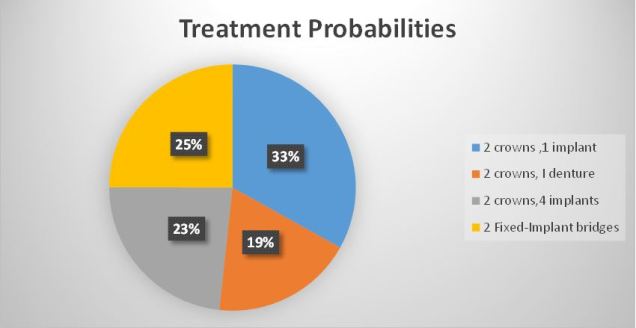
The avoid the cognitive error of subaddition the clinician/patient can only choose one option to follow, this is best represented as a pie-chart (Fig 1.).

TP1

Fig 1.

The conclusion when the treatment options are unpacked and compared is that the two bridges or the two crowns/four implants have about the same complication rate. The two crowns and the implant is the safest and the denture option has the highest failure rate.

There is however one more consideration and that is relative cost/benefit which is generally overlooked in the research literature. Fortunately, with the data above it is quite simple to calculate this using the concept of ‘expected value’ For this example I have used the total estimated cost of the treatment and multiplied it by the probability of a complication. To calculate the probability of any complication I used the formula (Table 2):

p(complication)=1-p(complication-free).

Treatment options Options Complication free Complications (P) Estimated Treatment Cost Estimated Value
2 crowns ,1 implant 2 x SC,1x SCI 0.79 0.21 3700 790
2 crowns, I denture 2 x SC, Co/Cr 0.44 0.56 2200 1228
2 crowns,4 implants 2 x SC, 4 x SCI 0.55 0.45 11200 4991
2 Fixed-Implant bridges 2 x F-I 0.59 0.41 6000 2443

Table 2.

TP2

Fig 2.

Hopefully it’s clear that initially the two crown, four implant option may be more appealing it does carry a significantly greater cost compared to the bridges. The safest treatment both in terms of cost and predictability is the shortened arch principle due to its simplicity.

The ‘take-home message’ is that as the number of treatment items increase for an individual, the risk of complications and cost can also increase. By taking a little time to ‘unpack’ the alternate treatment options it can help reduce overconfidence and clarify choice as part of the consent process.

References:

  1. Levin-Scherz J. What Drives High Health Care Costs. Harv Bus Rev [Internet]. 2010;88(4):72–3. Available from: http://www.ncbi.nlm.nih.gov/pubmed/20402058
  2. Redelmeier DA. Medical Decision Making in Situations That Offer Multiple Alternatives. JAMA J Am Med Assoc [Internet]. American Medical Association; 1995 Jan 25 [cited 2014 Mar 11];273(4):302. Available from: http://jama.jamanetwork.com/article.aspx?articleid=386588
  3. Liberman V, Tversky A, Redelmeier DA. The Psychology of Decision Making Probability Judgment in Medicine : 1995;
  4. Cahan A, Gilon D, Manor O, Paltiel O. Probabilistic reasoning and clinical decision-making: Do doctors overestimate diagnostic probabilities? QJM – Mon J Assoc Physicians. 2003;96(10):763–9.
  5. Käyser a F. Shortened dental arches and oral function. J Oral Rehabil. 1981;8(5):457–62.
  6. Reitemeier B, Hansel K, Kastner C, Weber A, Walter MH. A prospective 10-year study of metal ceramic single crowns and fixed dental prosthesis retainers in private practice set tings. J Prosthet Dent [Internet]. The Editorial Council of the Journal of Prosthetic Dentistry; 2013;109(3):149–55. Available from: http://dx.doi.org/10.1016/S0022-3913(13)60034-7
  7. PJETURSSON BE, LANG NP. Prosthetic treatment planning on the basis of scientific evidence. J Oral Rehabil [Internet]. 2008;35(s1):72–9. Available from: http://doi.wiley.com/10.1111/j.1365-2842.2007.01824.x
  8. Vermeulen a H, Keltjens HM, van’t Hof M a, Kayser  a F. Ten-year evaluation of removable partial dentures: survival rates based on retreatment, not wearing and replacement. J Prosthet Dent [Internet]. 1996 Sep;76(3):267–72. Available from: http://www.ncbi.nlm.nih.gov/pubmed/8887799