Auditing the Risk Index


Restorative Dentistry Risk Index Retrospective Test

To test the accuracy of the Restorative Dental Risk Index (RDRX) in predicting the survival of various dental treatments I carried out an audit of my own patients who had been with the practive for 10 years. To add perspective to the results I compared it to the Oral; Health Score (OHS), a modified commercial version of this is known as  Previsor. I have removed the post describing the RDRX to revise it slightly, it will be back by this week-end.

Method

Since we cannot have a 10 year no-treatment control I have used the Oral Health Score (OHS) as described by Burke and Busby as the control. As this is a health score it is by definition the inverse of the risk score so I have modified it by subtracting the OHS from 100 for comparison purposes (100-OHS).

Accessing Software of Excellence Excel I selected all current patients who first attended the practice between January and December 2005. I selected 10 years since the RDRX score was developed on 10 year survival/success meta-analysis data.

The query produced 47 sets of notes. I have assumed the effect size would be large 0.5, p=0.05 and power 0.8 so using G-Power 3.1 software the minimum sample size necessary was 21. I used a computer program to randomly selected 27 records from the 47 for review.

For each set of notes I counted the number of adverse events (failures and complications) and generated a RDRX score and 100-OHS based on the first visit. All major treatment provided in the past 10 years was categorised and recorded with the exception of maintenance and monitoring. (Data available on request)

Results and Analysis

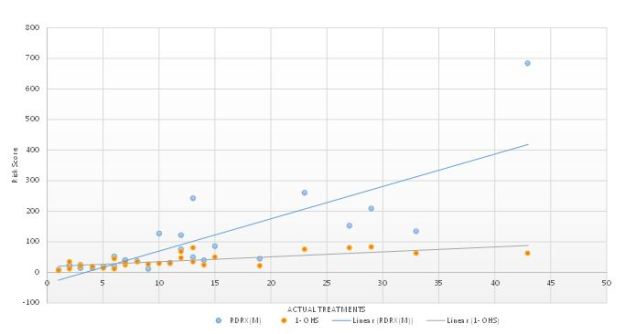
When comparing the risk scores with actual treatment both scoring systems perform well.

100 –OHS has a correlation coefficient 0.72

RDRX has a correlation coefficient 0.80
RDRX10

The second important comparison was the correlation between risk and estimated treatment cost

100 –OHS has a correlation coefficient 0.63

RDRX has a correlation coefficient 0.95
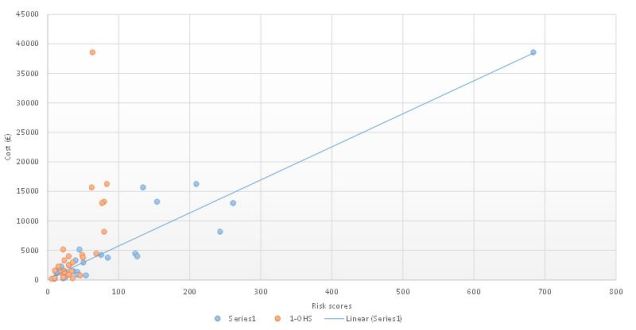
RDRX10a

I have also calculated a t-test between the two risk scores /actual treatment (one tailed) data sets. The value of t=2.38. The value of p is 0.013. The result is significant at p<0.05.

Conclusion

We can reject the null hypothesis that there is no difference between the two indices. There is an improvement is resolution when comparing the RDRX with actual treatment as we are not restricted by a maximum value of 100. This is even more obvious when comparing risk score with treatment costs.

Clinical risk is fat tailed where the highest risk patient inhabit the extremes and therefore we need to clearly identify the outliers. On a practical basis the RDRX is more objective by avoiding subjective input from the patient which in the OHS makes up 24% of the score. Additionally it is quicker and easier to directly audit as there is a tooth by tooth assessment rather than by sextant.

The utilisation of independent probabilistic tooth assessment and then the use of risk multipliers produces a clearer model of restorative situation and additionally can easily be converted from a score into a probability that can be verified by Brier Scoring (I will save that for another day).

The RDRX used in conjunction with words of estimative (WEP) probability fulfils the two further requirements of good risk communication which are: numerical magnitude and time frame.

The next stage I hope is to independently verify this data on a wider and more diverse population sample.


Probabilitistic Decision Making

Micro-specialisation and prognosis overestimation

I am a general dental practitioner, a jack-of-all trades in the dental world and possibly becoming an endangered species. To keep updated I travel to a lot of international conferences that cover the dental disciplines such as implants, restorative dentistry, prosthetics, endodontics, and periodontics to name a few. To my mind dentistry is a speciality within general healthcare so the disciplines above should be considered as sub-specialities or micro-specialities of dentistry and over recent years there has been a shift away from the generalist to the specialist (1). What I observed was that each discipline is just a bit better than the other at saving or restoring teeth so at an implant based conference implants outperform root-fillings and vice-versa.  Now if one carefully adds up the success rates across the disciplines of all the treatment options it becomes greater than 100%, which it impossible. What is happening is, due to uncertainty the  clinicians have to use probabilistic data and by restricting the number of treatment options create  overestimates for the relative success or suitability of that treatment. This is a problem of ‘subadditivity’ and the ‘unpacking principle’:

Subadditivity – This is where the sum of two probabilities is greater than 1.0.

Unpacking – As more detail of a hypothesis is provided (unpacked) there is an increase in its estimated probability.

An EBSCO literature search using the search terms “unpacking principle or subaddition” and “medical decision making” produced  three relevant papers with no systematic reviews or meta-analysis(2–4).To summarise the results; in Cahan et al’s paper 65% of the doctors exhibited subadditivity with a mean probability of 137% and Redelmeier et al concluded that clinicians need to unpack a broad category of treatment opptions rather than compare a single treatment against unspecified options.

To help understand these concepts I have worked an example for you below:

“A patient attends a dental surgeon complaining of difficulty chewing due to a loss of lower back teeth. On one side are two premolars and on the other one premolar. Both last standing teeth need new crowns. The upper arch is intact.”

The option are as follows:

  1. No treatment ( I will ignore this options in this example.)
  2. Two milled crowns and a metal/acrylic denture.
  3. Two crowns and a single implant following the shortened arch concept(5).
  4. Two crowns and four single implants. (Maximised model)
  5. Two tooth-implant retained three unit bridges (F-I).

The 10-year survival estimates for the individual components of the above treatment are:

  1. Single metal-ceramic crown 94% (6).
  2. Single tooth implant 89% (7)
  3. Tooth-implant bridge 77% (7)
  4. Metal acrylic denture 50% (8)

Looking at the individual survival figures the best treatment options involve metal-ceramic crowns on vital teeth or single crown implants, the next option is the tooth-implant bridge and finally the denture. The intuitive choice of most people would be Option 4.  (Two crowns and four single implants) due to the high survival rates. Once one becomes aware of the effects of subaddition and unpacking however Option 4. is not such a strong option as it at first appears in terms of complications and maintenance costs (Table 1.)


Unit treatment option 10-year Survival P Complete Treatment options Options Complication free
Implant Single crown (SCI) 89 0.89 2 crowns ,1 implant 2 x SC,1x SCI 0.79
Single crown (SC) 94 0.94 2 crowns, I denture 2 x SC, Co/Cr 0.44
Cobalt chrome denture (Co/Cr P) 50 0.5 2 crowns,4 implants 2 x SC, 4 x SCI 0.55
Fixed-implant bridge (F-I) 70 0.7 2 Fixed-Implant bridges 2 x F-I 0.49

Table 1.


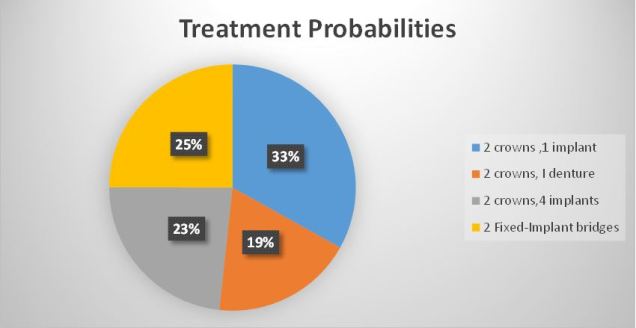
The avoid the cognitive error of subaddition the clinician/patient can only choose one option to follow, this is best represented as a pie-chart (Fig 1.).

TP1

Fig 1.

The conclusion when the treatment options are unpacked and compared is that the two bridges or the two crowns/four implants have about the same complication rate. The two crowns and the implant is the safest and the denture option has the highest failure rate.

There is however one more consideration and that is relative cost/benefit which is generally overlooked in the research literature. Fortunately, with the data above it is quite simple to calculate this using the concept of ‘expected value’ For this example I have used the total estimated cost of the treatment and multiplied it by the probability of a complication. To calculate the probability of any complication I used the formula (Table 2):

p(complication)=1-p(complication-free).

Treatment options Options Complication free Complications (P) Estimated Treatment Cost Estimated Value
2 crowns ,1 implant 2 x SC,1x SCI 0.79 0.21 3700 790
2 crowns, I denture 2 x SC, Co/Cr 0.44 0.56 2200 1228
2 crowns,4 implants 2 x SC, 4 x SCI 0.55 0.45 11200 4991
2 Fixed-Implant bridges 2 x F-I 0.59 0.41 6000 2443

Table 2.

TP2

Fig 2.

Hopefully it’s clear that initially the two crown, four implant option may be more appealing it does carry a significantly greater cost compared to the bridges. The safest treatment both in terms of cost and predictability is the shortened arch principle due to its simplicity.

The ‘take-home message’ is that as the number of treatment items increase for an individual, the risk of complications and cost can also increase. By taking a little time to ‘unpack’ the alternate treatment options it can help reduce overconfidence and clarify choice as part of the consent process.

References:

  1. Levin-Scherz J. What Drives High Health Care Costs. Harv Bus Rev [Internet]. 2010;88(4):72–3. Available from: http://www.ncbi.nlm.nih.gov/pubmed/20402058
  2. Redelmeier DA. Medical Decision Making in Situations That Offer Multiple Alternatives. JAMA J Am Med Assoc [Internet]. American Medical Association; 1995 Jan 25 [cited 2014 Mar 11];273(4):302. Available from: http://jama.jamanetwork.com/article.aspx?articleid=386588
  3. Liberman V, Tversky A, Redelmeier DA. The Psychology of Decision Making Probability Judgment in Medicine : 1995;
  4. Cahan A, Gilon D, Manor O, Paltiel O. Probabilistic reasoning and clinical decision-making: Do doctors overestimate diagnostic probabilities? QJM – Mon J Assoc Physicians. 2003;96(10):763–9.
  5. Käyser a F. Shortened dental arches and oral function. J Oral Rehabil. 1981;8(5):457–62.
  6. Reitemeier B, Hansel K, Kastner C, Weber A, Walter MH. A prospective 10-year study of metal ceramic single crowns and fixed dental prosthesis retainers in private practice set tings. J Prosthet Dent [Internet]. The Editorial Council of the Journal of Prosthetic Dentistry; 2013;109(3):149–55. Available from: http://dx.doi.org/10.1016/S0022-3913(13)60034-7
  7. PJETURSSON BE, LANG NP. Prosthetic treatment planning on the basis of scientific evidence. J Oral Rehabil [Internet]. 2008;35(s1):72–9. Available from: http://doi.wiley.com/10.1111/j.1365-2842.2007.01824.x
  8. Vermeulen a H, Keltjens HM, van’t Hof M a, Kayser  a F. Ten-year evaluation of removable partial dentures: survival rates based on retreatment, not wearing and replacement. J Prosthet Dent [Internet]. 1996 Sep;76(3):267–72. Available from: http://www.ncbi.nlm.nih.gov/pubmed/8887799


Preparation for Swiss Irontrail T121

The Heart of Snowdonia

IMG_0160


I took the opportunity of good weather and light winds to get a decent training session ready for the upcoming Swiss Irontrail in August. To get some strength into my legs I decided to use a route based on the Paddy Buckley Round(PBR) and the Heart of Snowdonia  Challenge Walk (HSCW) in North Wales.

The T121 is a 128.1km route with 6990m +/- starting and finishing in Davos, Switzerland (http://www.irontrail.ch/en/trails/t121/). My training goal for ultra-distance events is to comfortably complete 40%, this improves strength and stamina without creating too much tissue damage and has worked for both Ironman Triathlon and the Marathon des Sables.

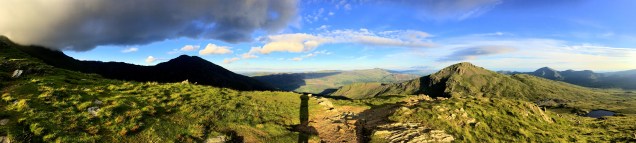
I started out at 10:30 on a warm but overcast morning outside the café in Capel Curig heading south past the Pla y Brennin Outward Bound Centre. Leaving the shrieks and squeals of kids learning to kayak behind, I ascended the path to Moel Siabod heading South. Once on top the weather cleared up and the sun came out giving some great views of the National Park. I avoided the descent down the back of Moel Siabod as per the HSCW since my map did not cover the area and followed the PBR along the ridge line to Cnicht. The route roughly follows an boundary fence and is very boggy. Once at Cnicht I reverted to the HSCW, the descent is quite steep and the rocky which is not helped by the rock strata being inconveniently angled. A note for the future would be to continue south about a kilometer and pick up the foot path to the lake. Once off the steep slope the descent to Geli Lago is quite beautiful and at this time of year the valley is an incredibly lush green. There are signs out informing the walker that they are building a micro-hydro to generate electricity of the local population which sounds quite innovative until you walk past the ruined farm and water-wheel.

IMG_0156
Sundew (Drosera Rotundifolia)


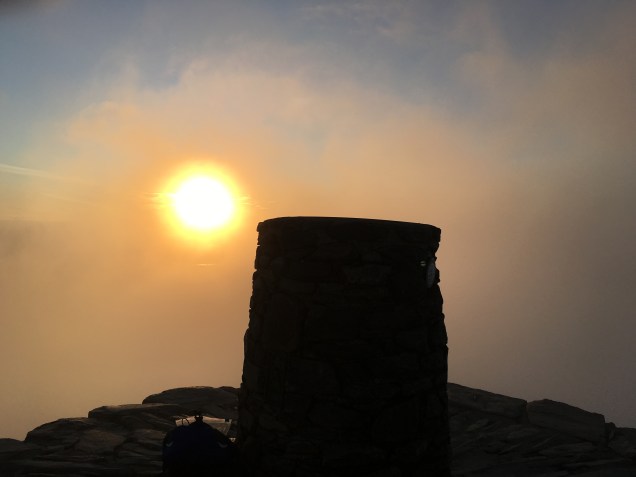
Crossing the road to Beddgelert the route ascends the Watkins path along the Afon Cwm Llan and veers left at the mine workings to take the ridge to Crib Tregalan. Evening was closing in now and though there were good views all around Snowdon summit was shrouded in cloud. I arrived at the summit just before sunset and got a couple of nice images as the clouds cleared. There were a few people getting ready to sleep on the summit so I had a terrible freeze dried meal and continued my walk to test out a new head torch.

IMG_0161
Snowdon Summit at Sunset

I quite like walking at night, it changes all the normal references but I decided to stop and bivi until dawn on top of Moel Cynghorion.There was a little light drizzle during the night but dawn was clear again as I descended the track to LLanberis past quite a few abandoned sheep farms and mine tailings.

IMG_0171


The view is dominated by the huge slate Dinorwic mine (1787-1969) above Llanberis going almost to the top of Elidir Fach.

IMG_0172

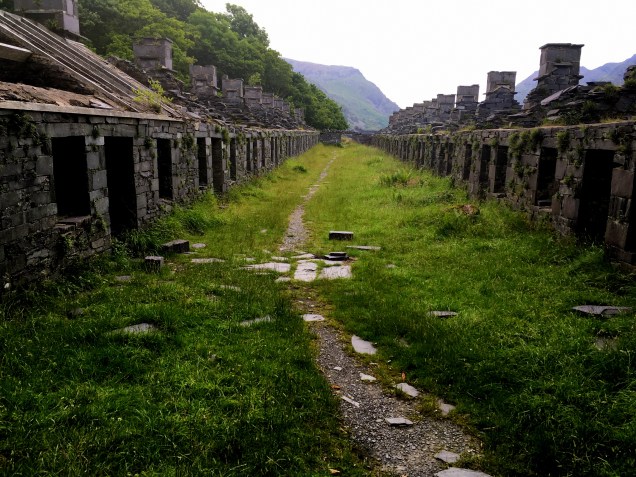
Llanberis is now quite a sleepy little town with lots of small camp sites and B+B’s but looking at the size of the old churches and Chapels reminds one that at its peak 3000 men worked in the quarry. The route leads up through the abandoned slate mine and is quite a sobering place when you think about the human labour involved getting the slate out of the mountain-side. Eventually the track changes from mine to open hill side disappears.  Ascending Elidir Fach and Fawr is quite hard as there is no obvious path on the Llanberis side until one has crossed the dragons back of loose boulders and can see Y Garn.

The last section is quite straight forward heading to the summit of Y Garn and then taking the west ridge down to Llyn Ogwen. The modern world returns as the small lake was teaming with visitors and school parties.

Total distance covered was 55km in 16 hrs.40min and total ascent 3881m. Perfect.