A SMOKERS GUIDE TO GOOD TEETH

A SMOKERS GUIDE TO GOOD TEETH

Posted on January 2, 2017

After twenty-eight years as a dentist, I know that is if you really want to irritate a smoker then give them the usual advice about the perils of smoking and why they should quit. Perhaps they enjoy their smoking, the mouth-feel and scratch at the back of the throat, having something the hold or the social rituals involved.cigarettes-78001_1280

In this short article, I would like to try and spin the discussion the other way around. How can you basically keep most the benefits of smoking and keep your mouth and teeth healthy? How is that possible?

In January 2016, the Cochrane Library/University of Oxford published “Electronic cigarettes for smoking cessation (Review)”(Hartmann-Boyce 2016). Over the past twenty years, Cochrane has been instrumental on selecting the best medical evidence so help health-care professionals and patient maker better choices. Where this review differed from others is that it acknowledged that “none adequately addresses the sensory and behavioral aspects of smoking that smokers miss when they stop smoking (e.g. holding a cigarette in their hands, taking a puff, enjoyment of smoking, etc.). Electronic cigarettes (EC’s) may offer a way to overcome this limitation or smoking cessation.”

e-cigarette-electronic_cigarette-e-cigs-e-liquid-vaping-cloud_chasing-vaping_at_work-work_vaping_16348990255

So how can we improve the health of our teeth? Well, the major cause of damage to the mouth comes from the chemicals in the smoke rather than the nicotine, so it would seem obvious that if we can get the smoke out of smoking, improvements will follow. At present, however there is little evidence to support this since EC’s have only been around for about ten years and well conducted oral health studies need to run for a long time since the damage can take years to appear.

  • If you take the smoke out of smoking it  could halve the amount of stain on the teeth based on a paper published in 2005 by the University College London (Alkhatib et al. 2005) where “Twenty-eight percent of smokers reported having moderate and severe levels of tooth discolouration compared to 15% in non-smokers”
  • How about reducing the risk of shrinking gums and mobile teeth. According to a study from the University of Dunedin, New Zealand (Zeng et al. 2014) by the time the long-term smokers had reached thirty-eight years old they had 23% more damage to their gums than the non-smokers and the men had more gum damage than the women.
  • What about keeping hold of our teeth, especially the upper teeth. To get an idea of losing teeth we have to look at some very large long term studies started in 1994 (Dietrich et al. 2015). This is tricky since it starts to showup after the age of fifty,  and then in the next ten years the risk goes up by 30% for men smoking more than fifteen cigarettes a day.
  • If you have had dental implants remember that smoking around 15 regular cigarettes/day can slightly more than double the risk of implant loss at 5-years for similar reasons to the problems with gum disease (Chrcanovic 2015).
  • And finally mouth cancer. Now before anyone panics, this is very rare so a 1.4 to 26-time increase in risk compared to a nonsmoker is still a small risk (Radoï & Luce 2013). The big variation is complicated by the small number of cases, location, and alcohol consumption. If caught early it’s one of the easiest cancers to treat but if left to develop has a poor survival rate of 50% at five-years.

cclogo-svg

So, back to the Cochrane review. Yes, we need more studies on how safe and effective EC’s really are in the long run. The review showed that using an “EC containing nicotine increased the chances of stopping smoking in the long term compared to using an EC without nicotine. We could not determine if EC was better than a nicotine patch in helping people stop smoking.” Therefore balancing the risk and the benefits, if you need the nicotine then at least consider an electronic cigarette as a first move and then reduce the nicotine if you are going to quit altogether. Good Luck.

References:

Alkhatib, M.N., Holt, R.D. & Bedi, R., 2005. Smoking and tooth discolouration: findings from a national cross-sectional study. BMC public health, 5, p.27. Available at: http://www.pubmedcentral.nih.gov/articlerender.fcgi?artid=1079878&tool=pmcentrez&rendertype=abstract.

Chrcanovic, A., 2015. Smoking and dental implants: A systematic review and meta-analysis. J Dent., 5, pp.487–98.

Dietrich, T. et al., 2015. Smoking, Smoking Cessation, and Risk of Tooth Loss: The EPIC-Potsdam Study. Journal of Dental Research, 94(10), pp.1369–1375. Available at: http://jdr.sagepub.com/cgi/doi/10.1177/0022034515598961.

Hartmann-Boyce, 2016. Electronic cigarettes for smoking cessation (Review). Cochrane database of systematic reviews (Online), 0(9), p.0. Available at: http://www.embase.com/search/results?subaction=viewrecord&from=export&id=L608013248%5Cnhttp://findit.library.jhu.edu/resolve?sid=EMBASE&issn=15320650&id=doi:&atitle=Electronic+cigarettes+for+smoking+cessation&stitle=Am.+Fam.+Phys.&title=American+Family+Ph.

Radoï, L. & Luce, D., 2013. A review of risk factors for oral cavity cancer: The importance of a standardized case definition. Community Dentistry and Oral Epidemiology, 41(2), pp.97–109.

Zeng, J. et al., 2014. Reexamining the Association Between Smoking and Periodontitis in the Dunedin Study With an Enhanced Analytical Approach. Journal of Periodontology, 85(10), pp.1390–1397. Available at: http://dx.doi.org/10.1902/jop.2014.130577.


EBM v. OBM

So if EBM means evidence based medicine what does OBM mean?

bury_your_head_in_the_sand

OBM = Ostrich-Based Medicine (substitute whatever you like for the last bit, be that medicine, healthcare, dentistry) where we ‘bury our heads in the sand’ to the consequence of our individual and collective actions.

No one individual can have enough personal knowledge and experience to constantly be giving the best advice to their patients and once we check our ego’s in at reception and admit that to our serves several things happen:


What we thought was best advice last year may not be anymore. Getting feedback in healthcare can take years before the consequences of our actions can be seen.


What we read, hear and see may not always be true.

As health-care professionals using a few basic research tools, we must question everything no matter how eminent the source. If someone says they have the evidence (politicians love to use the evidence word) we must have the courage to ask them to openly disclose it for critical appraisal. A lot of times their evidence is weak, second-hand or anecdotal.

EBM is about taking the ‘best available evidence’ not ignore everything except randomised controlled trails. Then taking into account our personal experience and skill sets apply that information to the situation in hand, this is the ‘black art’ as Dr Brian Goldman like to call it. Another thing to mention is that most published evidence is presented based on an average value for a group of people and we need to interpret that data and apply it to the individual.

Freakonomics on Bad Medicine

Here are the links to three great podcasts on evidence-based medicine.

freak

http://freakonomics.com/podcast/bad-medicine-part-1-story-98-6/#disqus_thread

Bad Medicine, Part 2: (Drug) Trials and Tribulations

http://freakonomics.com/podcast/bad-medicine-part-3-death-diagnosis/

Reading the comments section is quite interesting as it highlights a lot of the problems with evidence-based medicine (EBM). Once both the profession, industry, and patients become comfortable with the realities of uncertainty, feedback and our personal biases then understanding the philosophy behind EBM become clearer.

Probabilitistic Decision Making

Micro-specialisation and prognosis overestimation

I am a general dental practitioner, a jack-of-all trades in the dental world and possibly becoming an endangered species. To keep updated I travel to a lot of international conferences that cover the dental disciplines such as implants, restorative dentistry, prosthetics, endodontics, and periodontics to name a few. To my mind dentistry is a speciality within general healthcare so the disciplines above should be considered as sub-specialities or micro-specialities of dentistry and over recent years there has been a shift away from the generalist to the specialist (1). What I observed was that each discipline is just a bit better than the other at saving or restoring teeth so at an implant based conference implants outperform root-fillings and vice-versa.  Now if one carefully adds up the success rates across the disciplines of all the treatment options it becomes greater than 100%, which it impossible. What is happening is, due to uncertainty the  clinicians have to use probabilistic data and by restricting the number of treatment options create  overestimates for the relative success or suitability of that treatment. This is a problem of ‘subadditivity’ and the ‘unpacking principle’:

Subadditivity – This is where the sum of two probabilities is greater than 1.0.

Unpacking – As more detail of a hypothesis is provided (unpacked) there is an increase in its estimated probability.

An EBSCO literature search using the search terms “unpacking principle or subaddition” and “medical decision making” produced  three relevant papers with no systematic reviews or meta-analysis(2–4).To summarise the results; in Cahan et al’s paper 65% of the doctors exhibited subadditivity with a mean probability of 137% and Redelmeier et al concluded that clinicians need to unpack a broad category of treatment opptions rather than compare a single treatment against unspecified options.

To help understand these concepts I have worked an example for you below:

“A patient attends a dental surgeon complaining of difficulty chewing due to a loss of lower back teeth. On one side are two premolars and on the other one premolar. Both last standing teeth need new crowns. The upper arch is intact.”

The option are as follows:

  1. No treatment ( I will ignore this options in this example.)
  2. Two milled crowns and a metal/acrylic denture.
  3. Two crowns and a single implant following the shortened arch concept(5).
  4. Two crowns and four single implants. (Maximised model)
  5. Two tooth-implant retained three unit bridges (F-I).

The 10-year survival estimates for the individual components of the above treatment are:

  1. Single metal-ceramic crown 94% (6).
  2. Single tooth implant 89% (7)
  3. Tooth-implant bridge 77% (7)
  4. Metal acrylic denture 50% (8)

Looking at the individual survival figures the best treatment options involve metal-ceramic crowns on vital teeth or single crown implants, the next option is the tooth-implant bridge and finally the denture. The intuitive choice of most people would be Option 4.  (Two crowns and four single implants) due to the high survival rates. Once one becomes aware of the effects of subaddition and unpacking however Option 4. is not such a strong option as it at first appears in terms of complications and maintenance costs (Table 1.)


Unit treatment option 10-year Survival P Complete Treatment options Options Complication free
Implant Single crown (SCI) 89 0.89 2 crowns ,1 implant 2 x SC,1x SCI 0.79
Single crown (SC) 94 0.94 2 crowns, I denture 2 x SC, Co/Cr 0.44
Cobalt chrome denture (Co/Cr P) 50 0.5 2 crowns,4 implants 2 x SC, 4 x SCI 0.55
Fixed-implant bridge (F-I) 70 0.7 2 Fixed-Implant bridges 2 x F-I 0.49

Table 1.


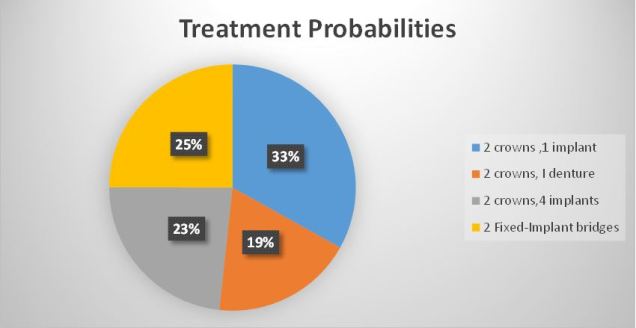
The avoid the cognitive error of subaddition the clinician/patient can only choose one option to follow, this is best represented as a pie-chart (Fig 1.).

TP1

Fig 1.

The conclusion when the treatment options are unpacked and compared is that the two bridges or the two crowns/four implants have about the same complication rate. The two crowns and the implant is the safest and the denture option has the highest failure rate.

There is however one more consideration and that is relative cost/benefit which is generally overlooked in the research literature. Fortunately, with the data above it is quite simple to calculate this using the concept of ‘expected value’ For this example I have used the total estimated cost of the treatment and multiplied it by the probability of a complication. To calculate the probability of any complication I used the formula (Table 2):

p(complication)=1-p(complication-free).

Treatment options Options Complication free Complications (P) Estimated Treatment Cost Estimated Value
2 crowns ,1 implant 2 x SC,1x SCI 0.79 0.21 3700 790
2 crowns, I denture 2 x SC, Co/Cr 0.44 0.56 2200 1228
2 crowns,4 implants 2 x SC, 4 x SCI 0.55 0.45 11200 4991
2 Fixed-Implant bridges 2 x F-I 0.59 0.41 6000 2443

Table 2.

TP2

Fig 2.

Hopefully it’s clear that initially the two crown, four implant option may be more appealing it does carry a significantly greater cost compared to the bridges. The safest treatment both in terms of cost and predictability is the shortened arch principle due to its simplicity.

The ‘take-home message’ is that as the number of treatment items increase for an individual, the risk of complications and cost can also increase. By taking a little time to ‘unpack’ the alternate treatment options it can help reduce overconfidence and clarify choice as part of the consent process.

References:

  1. Levin-Scherz J. What Drives High Health Care Costs. Harv Bus Rev [Internet]. 2010;88(4):72–3. Available from: http://www.ncbi.nlm.nih.gov/pubmed/20402058
  2. Redelmeier DA. Medical Decision Making in Situations That Offer Multiple Alternatives. JAMA J Am Med Assoc [Internet]. American Medical Association; 1995 Jan 25 [cited 2014 Mar 11];273(4):302. Available from: http://jama.jamanetwork.com/article.aspx?articleid=386588
  3. Liberman V, Tversky A, Redelmeier DA. The Psychology of Decision Making Probability Judgment in Medicine : 1995;
  4. Cahan A, Gilon D, Manor O, Paltiel O. Probabilistic reasoning and clinical decision-making: Do doctors overestimate diagnostic probabilities? QJM – Mon J Assoc Physicians. 2003;96(10):763–9.
  5. Käyser a F. Shortened dental arches and oral function. J Oral Rehabil. 1981;8(5):457–62.
  6. Reitemeier B, Hansel K, Kastner C, Weber A, Walter MH. A prospective 10-year study of metal ceramic single crowns and fixed dental prosthesis retainers in private practice set tings. J Prosthet Dent [Internet]. The Editorial Council of the Journal of Prosthetic Dentistry; 2013;109(3):149–55. Available from: http://dx.doi.org/10.1016/S0022-3913(13)60034-7
  7. PJETURSSON BE, LANG NP. Prosthetic treatment planning on the basis of scientific evidence. J Oral Rehabil [Internet]. 2008;35(s1):72–9. Available from: http://doi.wiley.com/10.1111/j.1365-2842.2007.01824.x
  8. Vermeulen a H, Keltjens HM, van’t Hof M a, Kayser  a F. Ten-year evaluation of removable partial dentures: survival rates based on retreatment, not wearing and replacement. J Prosthet Dent [Internet]. 1996 Sep;76(3):267–72. Available from: http://www.ncbi.nlm.nih.gov/pubmed/8887799