What is the most appropriate gown/apron for preventing Covid-19 contaminated fluids transfer in dental practice?

Originally posted on the Dental Elf

L0028811 A nurse and a surgeon, both wearing gown and mask. Etching b

Question:

Which gown/apron combination provides the best protection in the dental practice?

Bottom-line answer:

From this reanalysis of the primary data the reusable cotton surgical gown may be more practical in the dental environment in the long-term than the disposable fluid resistant gown due to its reduce potential for cross contamination during use. The plastic apron creates the most cross contamination and should only be used if there is significant risk of fluid contamination.

Background

This paper is a reanalysis of a recent systematic review (Verbeek et al., 2020) on personal protective equipment (PPE), reframing the question to fit into the new clinical workflow created by Covid-19, and dental aerosol generating procedures (AGPs). I have covered face masks in a previous post.

Much has been written on the epidemiology of Covid-19 and its transmissibility via contact, droplets, aerosols, or faeco-oral route. The main concern within dentistry being the aerosol generated during many routine dental procedures (Coulthard, 2020). To reduce this contamination risk Public Health England’s guidance document for personal protective equipment updated 3 May 2020 Section 10.4 (GOV.UK, 2020) states that:-

‘Disposable fluid repellent coveralls or long-sleeved gowns must be worn when a disposable plastic apron provides inadequate cover of staff uniform or clothes for the procedure or task being performed, and when there is a risk of splashing of body fluids such as during AGPs in higher risk areas or in operative procedures. If non-fluid-resistant gowns are used, a disposable plastic apron should be worn’.

As this advice is generic and the workflow within a critical care unit differs from a dental practice it is important to evaluate the best available evidence from a primary care rather than secondary care perspective.

Method

To save unnecessary duplication of search strategies and risk of bias/quality assessments I utilised the most up to date Cochrane Review of PPE for preventing highly infectious diseases due to exposure to contaminated body fluids in healthcare staff (Verbeek et al., 2020). This systematic review included 17 studies with 1950 participants evaluating 21 interventions. The authors concluded:

‘We found low- to very low-certainty evidence that covering more parts of the body leads to better protection but usually comes at the cost of more difficult donning or doffing and less user comfort, and may therefore even lead to more contamination. More breathable types of PPE may lead to similar contamination but may have greater user satisfaction.’

The authors conclusion helped to focus the next stage of analysis which was based around the levels of contamination and wearability. From the included studies two randomised simulation trials, one of a parallel design (Wong et al., 2004) and a second of a cross-over design (Guo et al., 2014) were selected as they contained sufficient primary data to undertake a meta-analysis. A simulation trial utilises aerosolised fluorescent dye sprayed on the PPE instead of true viral contamination. It was possible to extract data on contamination of  fluid resistant disposable gowns, standard cotton surgical gowns, and plastic aprons. The data was placed in Excel and then transferred to R for meta-analysis using the ’meta’ package. A random effect model was used with a Hartung Knapp conversion due to variability within the studies. Prediction intervals were included to facilitate the estimation for future studies.

Findings

The first meta-analysis compared a fluid resistant disposable gown with a standard cotton gown for both Wong and Guo. In Guo’s study the group tried two methods of doffing PPE: their individual accustomed removal method (IARM), and gown removal methods recommended by the Centers for Disease Control and Prevention (CDC).

The overall result favoured the cotton gown, but the result was non-significant, the mean difference (MD) was 0.91 (95%CI: -0.34 to 2.66) (See Figure 1.). The second meta-analysis showed significantly less contamination of the cotton surgical gowns compared with the plastic apron, the  MD was 8.4 (95%CI: 0.59 to 16.2) (See Figure 2.). The final analysis looked at the  contamination of the clinician post PPE removal showing equal contamination between the different PPE types MD was -0.02 (95% CI: -1.43 to 1.40) (See Figure 3).

Figure 1.Forest plot of disposable fluid resistant gown vs cotton gown
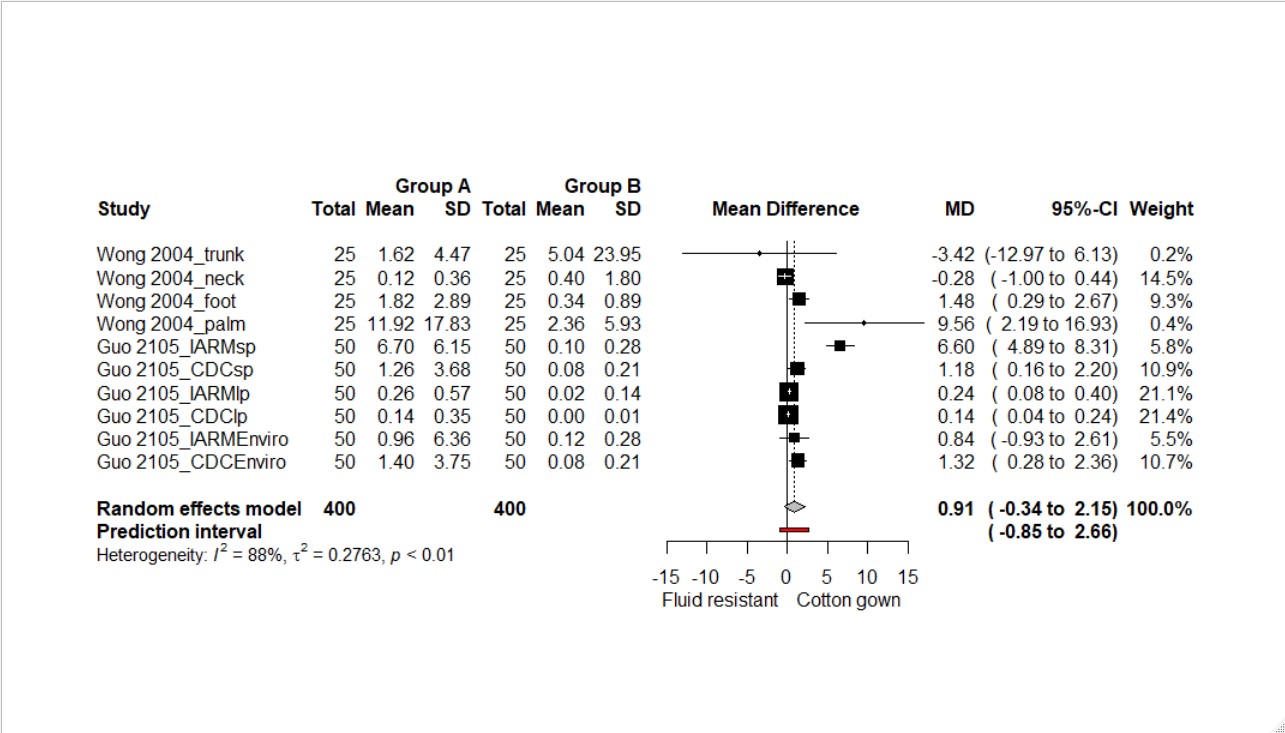
FIGURE 1

Figure 2. Forest plot of plastic apron vs cotton gown
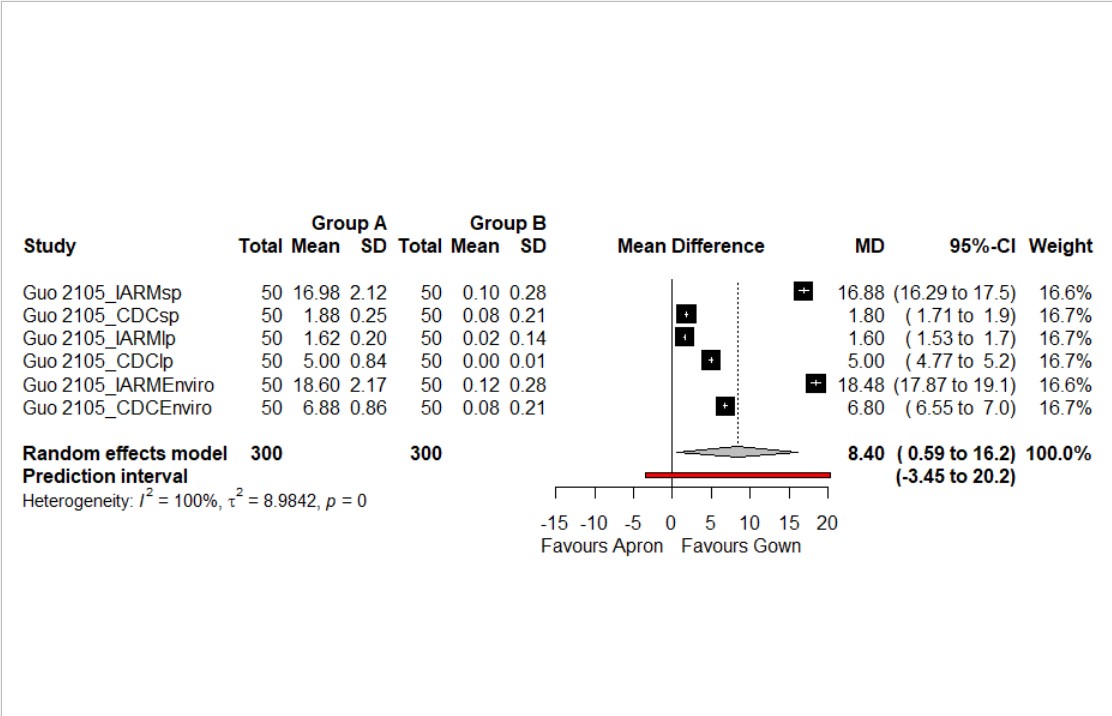
FIGURE 2.

Figure 3. Forest plot of body contamination
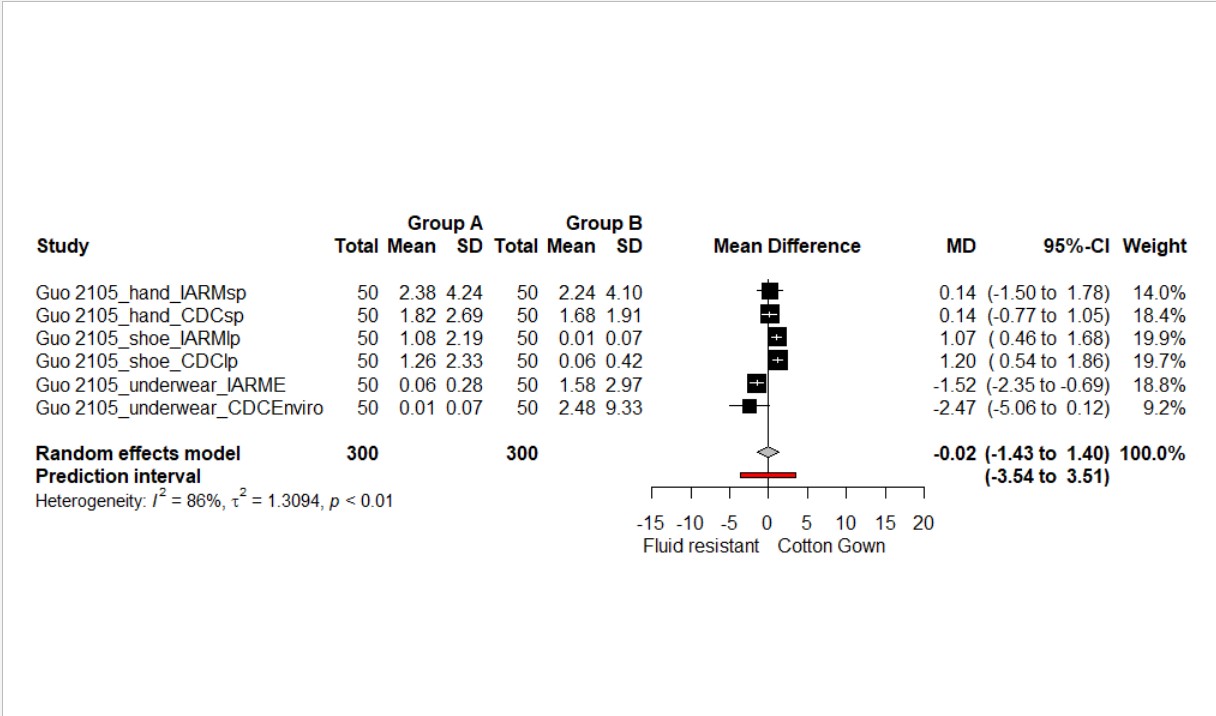
 FIGURE 3

Conclusion

From the results of the meta-analysis there is little difference between the disposable fluid resistant gown and the reusable cotton surgical gown in terms of contamination/protection of both the wearer, patient, and clinical environment. The results favour the cotton gown as cotton through its material and properties can absorb droplet contaminants and thereby reduce opportunities for such contaminants to spread to the environment. The plastic apron performed worst and may significantly increase the risk of cross contamination both to the clinician and patient and should only be necessary where there is a risk of serious fluid contamination.

There is an interesting paper recently published by Phan and co-workers (Phan et al., 2019) who observed that ‘90% of observed doffing was incorrect, with respect to the doffing sequence, doffing technique, or use of appropriate PPE. Common errors were doffing gown from the front, removing face shield of the mask, and touching potentially contaminated surfaces and PPE during doffing’.

These results presented are hypothetical and due to the lack of specific studies of virus penetration through gowns in dentistry and are based on surrogate, and composite outcomes. There is an urgent need for specific studies to address PPE performance in the dental surgery environment.

Disclaimer:  The article has not been peer-reviewed; it should not replace individual clinical judgement, and the sources cited should be checked. The views expressed in this commentary represent the views of the author and not necessarily those of the host institution. The views are not a substitute for professional advice.

References

COULTHARD, P. 2020. Dentistry and coronavirus (COVID-19) – moral decision-making. Br Dent J, 228, 503-505.

GOV.UK. 2020. COVID-19 ( personal protective equipment (PPE) [Online]. Available: https://www.gov.uk/government/publications/wuhan-novel-coronavirus-infection-prevention-and-control/covid-19-personal-protective-equipment-ppe [Accessed].

GUO, Y. P., LI, Y. & WONG, P. L. 2014. Environment and body contamination: a comparison of two different removal methods in three types of personal protective clothing. Am J Infect Control, 42, e39-45.

PHAN, L. T., MAITA, D., MORTIZ, D. C., WEBER, R., FRITZEN-PEDICINI, C., BLEASDALE, S. C., JONES, R. M. & PROGRAM, C. P. E. 2019. Personal protective equipment doffing practices of healthcare workers. Journal of occupational and environmental hygiene, 16, 575-581.

VERBEEK, J. H., RAJAMAKI, B., IJAZ, S., SAUNI, R., TOOMEY, E., BLACKWOOD, B., TIKKA, C., RUOTSALAINEN, J. H. & KILINC BALCI, F. S. 2020. Personal protective equipment for preventing highly infectious diseases due to exposure to contaminated body fluids in healthcare staff. Cochrane Database Syst Rev, 4, CD011621.

WONG, T. K., CHUNG, J. W., LI, Y., CHAN, W. F., CHING, P. T., LAM, C. H., CHOW, C. B. & SETO, W. H. 2004. Effective personal protective clothing for health care workers attending patients with severe acute respiratory syndrome. American journal of infection control, 32, 90-96.


Other  links

Personal protective equipment: a commentary for the dental and oral health care team on  Verbeek et al .

Eye protection and Covid-19

Medical staff combats COVID-19

What is the efficacy of eye protection equipment compared to no eye protection equipment in preventing transmission of COVID-19-type respiratory illnesses in primary and community care?(Khunti, 2020)


Link to The Dental Elf

Background

This rapid review asked whether, and in what circumstances lack of eye protection equipment is putting primary care clinicians at risk of contagion compared to use of eye protective equipment such as goggles. COVID-19 is spread by four means: via contact directly or contaminated surfaces; via droplet infection; via aerosols,  and aerosol generating procedures (AGPs)  which are created during many routine dental treatments; and finally the faeco-oral through poor hand hygiene. Even though there is limited evidence of Covid-19 virus being present in tears and conjunctival secretions there is a hypothetical risk that the virus could enter the body through the eye as a droplet or aerosol(Sun et al., 2020).

Methods

The Medline and Cochrane library digital databases were searched without date restrictions. Due to the large number of non-peer reviewed preprint publications in circulation they also conducted searches of Google Scholar. Critical appraisal of the systematic reviews was undertaken using the  AMSTAR II checklist (Shea et al., 2017).

Results

  • 52 randomised controlled trials and 12 systematic reviews were found on Medline.
  • 2 systematic reviews were assessed as good quality.
  • Verbeek (Verbeek et al., 2020) conducted a comprehensive Cochrane Review on the ‘Personal protective equipment for preventing highly infectious diseases due to exposure to contaminated body fluids in healthcare,’ and concluded there were no recent studies that investigated goggles or face shields.
  • French (French et al., 2016) identified two studies in which eye protection was used (eye–nose goggle or goggles plus masks) and found this to be effective in preventing transmission to staff (Agah et al., 1987, Gala et al., 1986). The control groups in both studies however were not wearing PPE so it was impossible to correctly evaluate the protective efficacy of the goggles from the face mask (See Table 1).

Table 1. Results from SR (French 2016)

Study Intervention Control Transmission risk in intervention group Transmission risk in intervention group
Agah et al, 1987 Goggles, mask and gowns No mask or goggles 5% (RSV illness rate) 61% (RSV illness rate)
Gala et al, 1986 Eye nose goggles No mask or goggles 5% 34%

RSV – Respiratory syncytial virus

Conclusion (Authors)

‘There is no direct evidence from randomised trials that eye protection equipment alone prevents transmission of COVID-19. Indirect evidence suggests that healthcare workers’ conjunctivae could be exposed to infective droplets and aerosols from patients during close contact. It is important to assess contagion risk of every encounter and take appropriate precautions   Where close contact is required, guidance for full personal protective equipment should be followed. For non-AGPs, there is no evidence from randomised trials that eye protective equipment provides additional protection’

Comments

In this well conducted rapid review the authors highlight the lack of direct evidence regarding the use of googles or face-shields in both non-AGP and AGP’s. There are many ethical reasons why there are so few studies and therefore current guidance is based on simulations using data from SARS and MERS outbreaks – as well as expert opinion, common sense, custom and practice. There is an urgent need for specific studies to address goggle and face shield performance in the dental surgery environment.

Disclaimer:  The article has not been peer-reviewed; it should not replace individual clinical judgement, and the sources cited should be checked. The views expressed in this commentary represent the views of the author and not necessarily those of the host institution. The views are not a substitute for professional advice.


Links


AGAH, R., CHERRY, J. D., GARAKIAN, A. J. & CHAPIN, M. 1987. Respiratory syncytial virus (RSV) infection rate in personnel caring for children with RSV infections: routine isolation procedure vs routine procedure supplemented by use of masks and goggles. American Journal of Diseases of Children, 141, 695-697.

FRENCH, C. E., MCKENZIE, B. C., COOPE, C., RAJANAIDU, S., PARANTHAMAN, K., PEBODY, R., NGUYEN‐VAN‐TAM, J. S., GROUP, N. R. S., HIGGINS, J. P. & BECK, C. R. 2016. Risk of nosocomial respiratory syncytial virus infection and effectiveness of control measures to prevent transmission events: a systematic review. Influenza and other respiratory viruses, 10, 268-290.

GALA, C. L., HALL, C. B., SCHNABEL, K. C., PINCUS, P. H., BLOSSOM, P., HILDRETH, S. W., BETTS, R. F. & DOUGLAS, R. G. 1986. The use of eye-nose goggles to control nosocomial respiratory syncytial virus infection. Jama, 256, 2706-2708.

KHUNTI, K. G., T. 2020. What is the efficacy of eye protection in primary care setting [Online]. Oxford COVID-19 Evidence Service. Available: https://www.cebm.net/covid-19/what-is-the-efficacy-of-eye-protection-equipment-compared-to-no-eye-protection-equipment-in-preventing-transmission-of-covid-19-type-respiratory-illnesses-in-primary-and-community-care/ [Accessed].

SHEA, B. J., REEVES, B. C., WELLS, G., THUKU, M., HAMEL, C., MORAN, J., MOHER, D., TUGWELL, P., WELCH, V. & KRISTJANSSON, E. 2017. AMSTAR 2: a critical appraisal tool for systematic reviews that include randomised or non-randomised studies of healthcare interventions, or both. bmj, 358, j4008.

SUN, C.-B., WANG, Y.-Y., LIU, G.-H. & LIU, Z. 2020. Role of the Eye in Transmitting Human Coronavirus: What We Know and What We Do Not Know. Frontiers in Public Health, 8.

VERBEEK, J. H., RAJAMAKI, B., IJAZ, S., SAUNI, R., TOOMEY, E., BLACKWOOD, B., TIKKA, C., RUOTSALAINEN, J. H. & KILINC BALCI, F. S. 2020. Personal protective equipment for preventing highly infectious diseases due to exposure to contaminated body fluids in healthcare staff. Cochrane Database Syst Rev, 4, CD011621.

How effective are free-standing clean air systems in dental practice?

red-heart-hot-air-balloon-flying-on-air-thumbnail

The question is: How effective are free-standing clean air systems in dental practice?

The bottom-line answer is: As with many of the rapid reviews and studies available regarding Covid-19 there is no direct evidence of the benefits of free-standing clean air systems in dental practice. Indirect evidence suggests a small but non-significant benefit that might easily by outweighed by their functionality in a working environment.

Discussion

From the available peer reviewed literature there are two types of air cleaning systems, both mostly a Class 13 high efficiency particulate air (HEPA) filter which can remove 99.95% of particulates. The first are free standing directional units that are large high-volume suction units placed about 1 m from the dental team (Hallier et al., 2010; Yamada et al., 2011). Both units reduced bacterial counts by about 30%. It should be noted that in Hallier and co-workers paper there was no statistical differences in bacterial counts created prior to the clean air system being activated between, history and examination, ultrasonic scaling with high volume suction (HVS), and tooth extraction. Cavity preparation was an outlier, the authors did not mention the use of HVS during this procedure unlike the scaling, as the bacterial count dropped by approximately 80% it suggests the use of normal HVS might be the significant factor here.

The second type of clean air system acts as a general air filter. There are two systematic reviews available, Eckmanns looked at mortality in highly immunosuppressed patients, and McDonald looked at asthma symptoms (Eckmanns et al., 2006; McDonald et al., 2002). The overall summary estimate for both reviews  weakly favoured the use of HEPA filters, but the results were not statistically significant using a random effects model (See Table 1).

Table 1. Summary Estimate for systematic reviews

Systematic review Study type Effect size 95%Confidence interval
McDonald et al 2002 RCTs (4) WMD = -0.76 -2.17 to 0.65
Eckmanns et al 2006 RCTs (6) RR = 0.86 0.65 to1.14
Eckmanns et al 2006 Non-RCTs (4) RR = 0.87 0.60 to 1.25
RR – relative risk  WMD – weighted mean difference

There is no direct evidence regarding UVC in air filters being able to kill Covid-19 (Narla et al., 2020; Shirbandi et al., 2020). There is an urgent need for specific studies to address air quality in the dental surgery environment.

Disclaimer:  The article has not been peer-reviewed; it should not replace individual clinical judgement, and the sources cited should be checked. The views expressed in this commentary represent the views of the author and not necessarily those of the host institution. The views are not a substitute for professional advice.


REFERENCES

ECKMANNS, T., RÜDEN, H. & GASTMEIER, P. 2006. The influence of high-efficiency particulate air filtration on mortality and fungal infection among highly immunosuppressed patients: a systematic review. The Journal of infectious diseases, 193, 1408-1418.

HALLIER, C., WILLIAMS, D. W., POTTS, A. J. C. & LEWIS, M. A. O. 2010. A pilot study of bioaerosol reduction using an air cleaning system during dental procedures. British Dental Journal, 209.

MCDONALD, E., COOK, D., NEWMAN, T., GRIFFITH, L., COX, G. & GUYATT, G. 2002. Effect of air filtration systems on asthma: a systematic review of randomized trials. Chest, 122, 1535-42.

NARLA, S., LYONS, A. B., KOHLI, I., TORRES, A. E., PARKS‐MILLER, A., OZOG, D. M., HAMZAVI, I. H. & LIM, H. W. 2020. The Importance of the Minimum Dosage Necessary for UVC Decontamination of N95 Respirators during the COVID‐19 Pandemic. Photodermatology, Photoimmunology & Photomedicine.

SHIRBANDI, K., BARGHANDAN, S., MOBINFAR, O. & RAHIM, F. 2020. Inactivation of Coronavirus with Ultraviolet Irradiation: What? How? Why?

YAMADA, H., ISHIHAMA, K., YASUDA, K., HASUMI-NAKAYAMA, Y., SHIMOJI, S. & FURUSAWA, K. 2011. Aerial dispersal of blood-contaminated aerosols during dental procedures. Quintessence international (Berlin, Germany : 1985), 42, 399-405.