Which occupations have the highest potential exposure to the coronavirus (COVID-19)?

The Office for National Statistics (ONS) has created an estimate of exposure to generic disease, and physical proximity to others, for UK occupations based on US analysis of these factors (ONS, 2020).
Dental-Hygienist

Link to The Dental Elf

Background

The ONS  produced a bubble plot on the 11th May to illustrate in their own words the:

‘clear correlation between exposure to disease, and physical proximity to others across all occupations. Healthcare workers such as nurses and dental practitioners unsurprisingly both involve being exposed to disease on a daily basis, and they require close contact with others, though during the pandemic they are more likely to be using PPE.’

From the plot it is clear to see that dentistry (dentist and dental nurse) are in the extreme top right corner denoting the highest exposure to disease and closes proximity to other people in the workplace, not only patients but also staff (See Figure 1).

Figure 1.  ONS Exposure to disease vs proximity to others

Bubble_v1

It is extremely easy to misinterpret this chart and I would argue this could be a classic case of  ‘correlation does not imply causation’.  Though technically we are as a profession, very close to our patients faces this does not imply that we, or the patients are at higher risk of catching a disease. Since the emergence of Human Immunodeficiency Virus (HIV) in the early 1980’s the dental profession has been fully aware of the risk that blood bourne (HepB+C), and respiratory infections (TB, SARS, MERS, H1N1) pose to both the patients, staff and population in general. The use of high levels of personal protective equipment (PPE), and staff who are specially trained in decontamination and cross infection measures has been normalised in the dental profession for over forty years.

Methods

To illustrate this, I thought it might be interesting to see how the dental profession compared to similar professional groups using the ONS’s ‘Occupations and exposure to disease’ and  ‘All death occurrences at ages 16 to 74 in England and Wales between 2001 and 2010’ data sets. From the 299 diagnostic codes for mortality I selected the 24 codes that represented respiratory disease excluding cancer (See Annex A). From this data five additional groups were selected where the demographics and data were comparable to dentist’s socio-economically, the 10 years mortality rate and relative risk were calculated based on weighted means.

Results

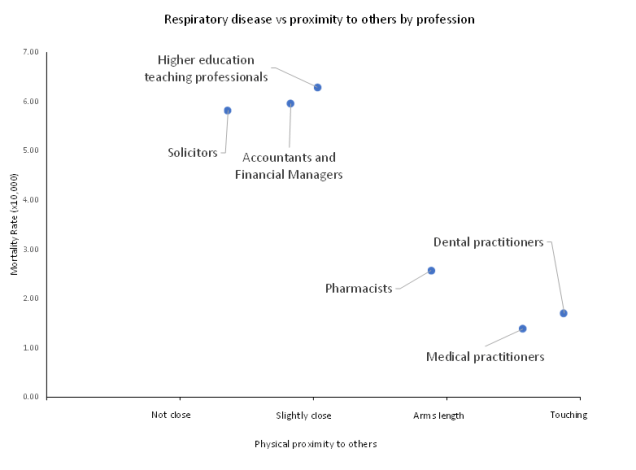
There were six professional groups were dentists, doctors, pharmacists, solicitors, higher education teaching professionals, and accountants/financial managers. Broadly speaking even though the dentists are physically closest to the patient, and potentially at the greatest risk of exposure they had 3.5 times  less respiratory disease than their non-healthcare peers. Doctors were just slightly lower risk than the dentist (See Figure 1., Table 1.)

Figure 1. Respiratory disease vs profession
respvsprof

Table 1. Occupation data.

Occupation title Dentists Doctors Pharmacists Solicitors Higher education Accountants
Proximity to others(ONS units?) 97.0 89.2 72.0 34.0 50.7 45.75
Exposure to disease(ONS units?) 90.0 91.2 76.0 14.0 11.1 3.4
Total in employment 41,000 296,000 70,000 122,000 178,000 361000
Percentage female 52.6 48.9 67.6 56 46.4 44.8
Percentage aged 55+ 11.8 16.5 14.9 18.9 25.8 16.9
Percentage BAME 28.2 27.9 32.4 14.4 9.9 11.3
Respiratory disease male age 16 to 64(excl. cancer) 6 33 10 59 95 169
Respiratory disease female age 16 to 64 (excl. cancer) 1 8 8 12 17 46
Respiratory disease total age 16 to 64 (excl. cancer) 7 41 18 71 112 215
Mortality rate (MR)x10^-4 1.71 1.39 2.57 5.82 6.29 5.96
Relative risk (RR) 1.00 0.81 1.51 3.41 3.69 3.49

 Discussion

From the data presented in this opinion piece we can clearly see that the dental profession works in an environment that poses a high risk of exposure to respiratory disease. We can also see that as a profession we suffer less respiratory disease than our peers, especially those not working in the healthcare sector, and I would propose this is due to the high degree of training regarding cross-infection and careful use of PPE. It is important however to remember that this data was collected between 2001 and 2010 so it does not represent the current situation regarding Covid-19.

Disclaimer:  The article has not been peer-reviewed; it should not replace individual clinical judgement, and the sources cited should be checked. The views expressed in this commentary represent the views of the author and not necessarily those of the host institution. The views are not a substitute for professional advice.

References

ONS. 2020. Which occupations have the highest potential exposure to the coronavirus (COVID-19)?[Online].Available: https://www.ons.gov.uk/employmentandlabourmarket/peopleinwork/employmentandemployeetypes/articles/whichoccupationshavethehighestpotentialexposuretothecoronaviruscovid19/2020-05-11 [Accessed].

Appendix

Appendix A. Respiratory diseases(excluding cancer)

Respiratory Disease
Influenza
Tuberculosis
Viral pneumonia
Pneumococcal pneumonia
Other bacterial pneumonia
Other specified pneumonia
Bronchopneumonia
Unspecified lobar pneumonia
Unspecified pneumonia
Acute bronchitis/bronchiolitis
Chronic bronchitis and emphysema
Asthma
Bronchiectasis
Coal worker’s pneumoconiosis
Asbestosis
Silicosis
Other and unspecified pneumoconiosis
Pneumoconiosis with tuberculosis
Byssinosis
Airways disease due to other specific organic dust
Farmer’s lung disease
Bird fancier’s lung
Other and unspecified allergic pneumonitis
Respiratory conditions from chemical fumes
Pulmonary fibrosis


Recommendations for the re-opening of dental services: a rapid review of international sources

International_flag_globe

Link to Dental Elf

The coronavirus 2 (SARS-CoV-2 (Covid-19)) pandemic has shut, or severely restricted the provision of only but the most essential dental care globally. From the data now currently available we have past the initial peak of infection within the population but it may still take a considerable time to develop a treatment or vaccine for the virus, in the meantime we will have to learn to function with the virus in the community. The purpose of this rapid review was to scope through the current international guidelines on re-opening dental services to help policy and decision makers establish robust practical evidence-based guidelines (Cochrane, 2020).

 Methods

 Between the 2nd and 6th May a rapid review was conducted of the international guidance  for reopening dental services utilising the WHO and the Alliance for Health Policy and Systems Research approach. A grey literature search was undertaken with the assistance of the information scientists at Cochrane Oral Health. Single data extraction was performed and quality was not assessed or validated.

Results

  • The review identified 12 guidance documents from 11 countries between the 18th March to the 5th
  • Below are listed the recommendations by domain that scored >50%:
    • Practice preparation and patient considerations
      • Patient triage by telephone (92%)
      • Social distancing in the waiting area reception (75%)
    • PPE for dental practice personnel
      • Always wear face mask (67%)
      • Unsuspected COVID-19 patients
        • Eye protection (100%)
        • FFP2 mask (50%)
      • Unsuspected COVID-19 patients undergoing AGPs
        • Disposable surgical gown (75%)
        • FFP2 mask (67%)
        • Surgical hat (50%)
      • Confirmed COVID19 patients
        • Eye protection, single use of gloves and disposable surgical gown (100%)
        • FFP2 mask (75%)
        • Surgical hat (67%)
      • Confirmed COVID19 patients undergoing AGPs
        • FFP2 mask (83%)
      • Management of the clinical room
        • Clinical room should be kept clear (50%)
      • Dental procedures.
        • Reduce or avoid AGPs (100%)
        • Reduce the risk of transmission (92%)
        • Rubber dam and high-volume suction (83%)
        • High volume suction (92%)
        • Minimally invasive procedures (50%)
      • Post-operative cleaning/disinfection/waste management
        • Cleaning and disinfection of all surfaces following every patient contact (75%)

Conclusions

The authors concluded:

‘This rapid review has provided a summary of the international guidance documents published to date. It summarises the main elements of the included documents and highlights several key messages intended to assist policy and decision makers to produce comprehensive national guidance for their own settings. In the majority of the sources addressing specific COVID-19 concerns, there was no referenced, underpinning evidence’.

 Comments

This rapid review generated a substantial volume of data that can be challenging to interpret. To help develop some context of the balance of information I extracted data both at the domain and subgroup level to produce a summary weight of consensus per domain (See Figure 1.).

RR_international

What the chart shows us is that there is a high degree of agreement about the clinical aspects of managing individual dental patients, as seen from the PPE and procedures domains, even though there is weak evidence supporting these recommendations. Guidance on how we are going to solve the re-opening problem is significantly weaker (p=0.01) in the domains of practice preparation and patient considerations, management of the clinical room, and post-operative procedures. There is nothing new here in terms of guideline construction as they are generally formulated with very little stakeholder involvement, evidence-base, or applicability (Domains 2,3 and 5 of the AGREE II criteria) (Howe, 2017). The purpose of the review was to identify these weaknesses and address them in the future guideline  development.

Disclaimer:  The article has not been peer-reviewed; it should not replace individual clinical judgement, and the sources cited should be checked. The views expressed in this commentary represent the views of the author and not necessarily those of the host institution. The views are not a substitute for professional advice.

References

COCHRANE. 2020. Recommendations for the re-opening of dental services: a rapid review of international sources [Online]. Available: https://oralhealth.cochrane.org/news/recommendations-re-opening-dental-services-rapid-review-international-sources [Accessed].

HOWE, M. S. 2017. What is the methodological quality of published dental implant guidelines? Evid Based Dent, 18, 35-36.

Which comes first, the mask or the gown?

Dental Elf link

surgery-hospital-doctor-care-royalty-free-thumbnail

As the profession starts planning its phased return to clinical work in dental practice I thought it would be a good time to look through the updated ‘COVID-19: personal protective equipment use for aerosol generating procedures (AGPs)’ from Public Health England (PHE, 2020), and I became immediately confused as I referred back to my oral surgery training. Which comes first, the mask or the gown? It was quite challenging to find any recent primary research papers on surgical donning protocols so  I have referenced a recent protocol from the NHS Foundation Trust (Newcastle_Hospitals, 2017). The two protocols are presented below (See Table 1.).

Public Health England

donning instructions for AGPs

Newcastle upon Tyne Hospitals standard surgical protocol
1.     Remove jewellery 1.    Remove jewellery
2.     Tie hair back 2.    Tie hair back + disposable surgical cap
3.     Hand hygiene 3.    Respirator/surgical mask
4.     Gown 4.    Eye protection/visor
5.     Respirator 5.    Hand hygiene
6.     Eye protection/visor 6.    Gown
7.     Gloves 7.    Gloves

Table 1. Comparative donning protocols

The protocols diverge after Stage 2 where the standard surgical protocol involves wearing a surgical cap to prevent the possible contamination of the sterile field by falling hair, but also to prevent contamination of the hair during AGP’s/surgery. The protocol then goes, respirator/surgical mask, eye protection, hand hygiene, gown, and finally gloves. This process reduces the risk of cross contamination of the hands, gown, and gloves prior to treatment. The PHE guidance flips the protocol around where the hands are washed, then the gown, respirator, eye protection, and finally gloves are donned. The contentious area is that if the PPE following the PHE protocol needs to be replaced for the next patient there is an increased risk of cross contamination from the clinicians hands as they have now touched the head, face, ears and gown prior to gloving , this could be reduced in the standard surgical protocol. It would appear that the PHE guidelines are possibly based on an American Centre for Disease Control document from 2007(CDC, 2007) regarding ‘isolation precautions for preventing transmission of infectious agents in healthcare settings’ which then evolved into their ‘PPE guidelines for coronavirus disease’ (CDC, 2020). These guidelines were developed for treating patients in isolation wards where the number of actively infected individuals would be close to 100% (WHO, 2020) rendering cross contamination negligible as all the patients already have the disease.

At present there is a high degree of uncertainty over the prevalence of infected/recovered individuals in the population who could attend a dental surgery for treatment, this uncertainty increases the possibility of cross infection via the sessional use of PPE if an asymptomatic patient should attend for treatment. This also holds true if the PPE is going to be changed between AGPs as there is also a risk of cross contamination of the new PPE, wearer, and surgery environment if doffing and re-donning is not performed perfectly. In a study by Phan and co-workers they found that 11% of scrub samples, and 7% of face samples were positive for respiratory virus after doffing (Phan et al., 2019b), and overall 90% of observed doffing was incorrect (Phan et al., 2019a). As a precautionary principle perhaps these small but important changes in the donning of PPE should be considered; mask, visor, hand hygiene, then gown and gloves. The concern here is not about maintaining sterility as in routine surgery but trying to avoid virus transfer to the new PPE while we await more data on the risk posed by AGPs of dental origin to both the patients and the dental team.

Disclaimer:  The article has not been peer-reviewed; it should not replace individual clinical judgement, and the sources cited should be checked. The views expressed in this commentary represent the views of the author and not necessarily those of the host institution. The views are not a substitute for professional advice.

References

NEWCASTLE_HOSPITALS. 2017. Surgical Scrub, Gown and Glove Procedure [Online]. The Newcastle upon Tyne Hospitals NHS Foundation Trust. Available: http://www.newcastle-hospitals.org.uk/downloads/policies/Infection%20Control/SurgicalScrubGownandGloveProceduresPolicy201706.pdf [Accessed].

PHE.2020. PHE COVID-19 Donning quick guide gown version [Online]. Public Health England. Available: https://www.gov.uk/government/publications/covid-19-personal-protective-equipment-use-for-aerosol-generating-procedures [Accessed].

CDC. 2007. Guideline for Isolation Precautions: Preventing Transmission of Infectious Agents in Healthcare Settings (2007) [Online]. Available: https://www.cdc.gov/infectioncontrol/guidelines/isolation/index.html [Accessed].

CDC.2020. Using Personal Protective Equipment (PPE) [Online]. Available: https://www.cdc.gov/coronavirus/2019-ncov/hcp/using-ppe.html [Accessed].

PHAN, L. T., MAITA, D., MORTIZ, D. C., WEBER, R., FRITZEN-PEDICINI, C., BLEASDALE, S. C., JONES, R. M. & PROGRAM, C. P. E. 2019a. Personal protective equipment doffing practices of healthcare workers. Journal of occupational and environmental hygiene, 16, 575-581.

PHAN, L. T., SWEENEY, D., MAITA, D., MORITZ, D. C., BLEASDALE, S. C., JONES, R. M. & PROGRAM, C. D. C. P. E. 2019b. Respiratory viruses on personal protective equipment and bodies of healthcare workers. Infect Control Hosp Epidemiol, 40, 1356-1360.

PHE. 2020. PHE COVID-19 Donning quick guide gown version [Online]. Public Health England. Available: https://www.gov.uk/government/publications/covid-19-personal-protective-equipment-use-for-aerosol-generating-procedures [Accessed].

WHO 2020. Rational use of personal protective equipment for coronavirus disease (COVID-19): interim guidance, 27 February 2020. World Health Organization.